Quick Guide on Dharma
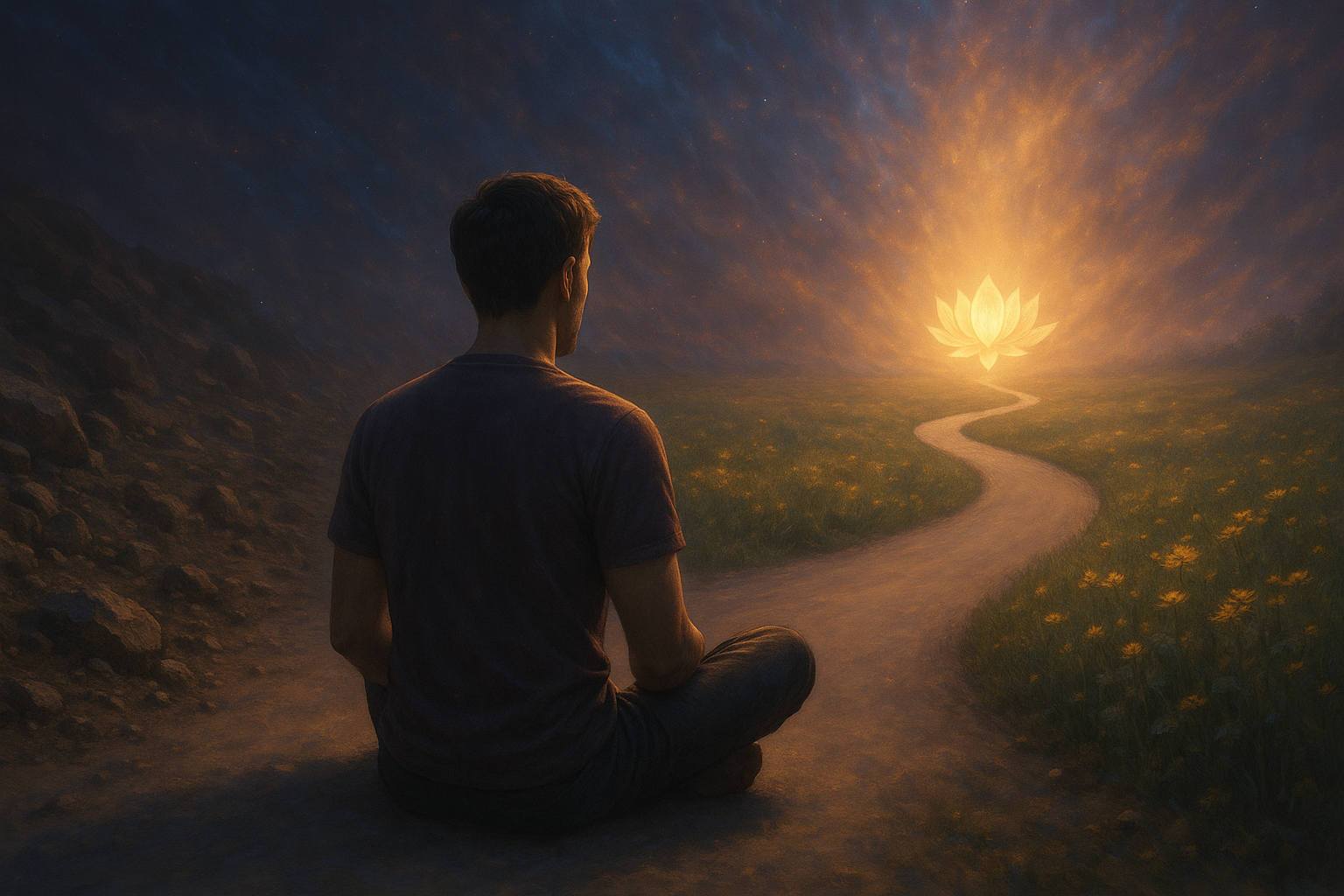
The Mahabharat is a well-known ancient Bharatiya (Indian) epic that masterfully weaves mythology, philosophy, politics, ethics, and human psychology into the sweeping story of a dynastic conflict between the Pāṇḍavas and Kauravas. Spanning seven generations over more than a hundred years in duration, it features over 1,000 named characters and remains the longest known epic, with over 100,000 verses.
At its core lies the Bhagavad Gita, a revered dialogue on duty, self-realization, and spiritual wisdom. The Mahabharat has shaped Bharat’s literature, law, governance, and moral discourse for centuries. Its enduring relevance lies in its exploration of dharma — righteousness — as a nuanced, evolving principle that guides individuals through complex moral choices. Through its epic scale and intimate dilemmas, it reflects not just heroic ideals but the full spectrum of human experience.
As the embodiment of Sanatan Dharma, or eternal order, the Mahabharat presents dharma not as rigid law but as contextual and deeply personal. Its teachings offer timeless guidance for navigating the balance between personal desire and universal duty, between action and renunciation, making it both a spiritual compass and a mirror for society.*
At one point, even the epic itself makes a confident claim that:
धर्मे चार्थे च कामे च मोक्षे च भरतर्षभ।
यदिहास्ति तदन्यत्र यन्नेहास्ति न तत् क्वचित्॥
This essentially says that whatever is in this epic regarding dharma (righteousness), artha (wealth), kama (desire, pleasure), and moksha (liberation), it may be found elsewhere too in part or full. But anything that is not here, will be found nowhere else.
The Bhagavad Gita is a dialogue, in the backdrop of a battlefield, between two close friends, both evolved souls, each one quick to grasp the intent and context of each other’s questions and concise responses. Ved Vyas, through the stories and long form of Mahabharat attempts to give context, cause and consequences that are easy to visualize, connect to and understand.
The closing lines, the closing thoughts and ideas of an epic are most crucial as they helps to ensure that the reader, or the listener takes the most potent lessons and learnings from it.
The same is true with Mahabharat. In this blog, we will briefly look at the last four shlokas (verses) of the Mahabharat. Each a gem, rich and potent. Read and reflect. The last book, the 18th, is named “Svargārohaṇa Parva (The Book of the Ascent to Heaven)” and chapter 5 has the concluding verses.
##Shloka 47 — Fourth last: Book 18, Chap 5##
माता पितृसहस्राणि पुत्रदारशतानि च ।
संसारेष्व अनुभूतानि यान्ति यास्यन्ति चापरे ॥
Thousands of mothers and fathers, several kids and siblings and friends and enemies, we all have. The cycle of life continues. We have discussed that Mahabharat is full of stories of great kings and greater sages, even GODs, and their big destinies and declines, their soaring egos and humbling defeats.
With this one shloka, the author brushes all the big egos into dust by stating that the world and life continue, no matter what.
##Shloka 48: Third Last: Book 18, Chap 5##
हर्षस्थान सहस्राणि भयस्थान शतानि च ।
दिवसे दिवसे मूढम आविशन्ति न पण्डितम ॥
Life is a string of thousands of happy moments, and some sad moments. And yet, we preoccupy ourselves, consume ourselves, with those few sad ‘unhappy’ moments and forget the joys and pleasures of thousands of happy ones. In the process, we make our life into a curse.
##Shloka 49: Second Last: Book 18, Chap 5##
ऊर्ध्वबाहुर विरौम्य एष न च कश चिच छृणॊति ।
मे धर्माद अर्थश च कामश च स किमर्थं न सेव्यते ॥
I pray, why no one listens to me, that serves your dharma and it will deliver you kama(desires) and moksha, but no one does. Essentially saying do your dharma, and it will deliver you.
##Shloka 50: The Last one: Book 18, Chap 5##
न जातु कामान न भयान न लॊभाद: ।
धर्मं तयजेज जीवितस्यापि हेतॊः ॥
नित्यॊ धर्मः सुखदुःखे तव अनित्ये: ।
जीवॊ नित्यॊ हेतुर अस्य तव अनित्यः ॥
Under all pressures, distractions, whatever happens, never stop doing dharma (duties of the role of life you are in) without even worrying about outcomes, happens or not, as desired.
This is the most intriguing closing verse of any. It tells us to do dharma, no matter what. Even when you feel like no progress is made, no desired outcomes are coming your way, when doubts arise, when frustrations and fatigue set in, and when you feel like questioning everything. On the promise of the previous shloka49, Mahabharat insists you should continue performing your karmas based on your dharma.
Many times, I wonder why the 49th and 50th shlokas were not interchanged. Especially because the 49th still has an optimistic tone. But then, upon reflection, I like the 50th as the last shloka because it is about realism. The essence of Mahabharat is about recognizing and living in realism.
So what is dharma?
Many religious traditions explain right and wrong through fixed rules. Judaism and Christianity articulate moral life through the Ten Commandments, while Islam presents core ethical injunctions through verses in the Qur’an. These traditions offer relatively stable guidelines that apply broadly and consistently.
Sanatan Dharma (often called Hinduism) works differently. It offers no single, universal list of do’s and don’ts that applies to everyone, everywhere, at all times. This is not an omission or a weakness; it is a deliberate design.
Rather than commandments, dharma is understood as right action in context — action that upholds balance, continuity, and integrity in life and society. Dharma is not rigid or static. It responds to time, place, responsibility, and circumstance. What is right is therefore not always fixed in form, even though it remains anchored in enduring principles.
Dharma is not a rulebook. Dharma is knowing what is right thing to do. Karma is the action you do.
This naturally raises a practical question: if dharma is so fluid, how does one know what one’s dharma is, or whether what one is doing is actually right? There is no simple checklist that answers this. What the tradition offers instead is a way of thinking — a framework for discernment.
Principles in Practice: Context, Conflict, and Choice
Certain values form a moral baseline across cultures: honesty, avoiding unnecessary harm, fairness, compassion, restraint, and integrity. These principles do not dictate specific actions, but they set boundaries. When an action violates them without necessity, it is unlikely to be dharmic.
Beyond this baseline, dharma becomes contextual. Responsibilities differ by role, stage of life, temperament, and circumstance. What is right for one person or one phase of life may be wrong for another. Dharma therefore cannot be reduced to a single formula.
This becomes most visible when duties conflict or circumstances are difficult. Life often places us in situations where responsibilities pull in different directions, or where ordinary norms feel insufficient. In such moments, dharma is not about rigidly applying rules. It is about weighing consequences, minimizing harm, and preserving long-term balance.
The Bhagavad Gita makes a crucial distinction here: outcomes are never fully within our control. What is within our control is the quality of our action — whether it is performed with clarity, steadiness, and freedom from fixation on results.
What is right for one person, or one phase of life, may not be right for another.
Recognizing Dharmic Action
Dharma is lived, not prescribed. It is not judged like a rule, but discerned in context through responsible attentiveness to what each moment requires. It asks not for certainty or perfection, but for sincere commitment to the best action one can see.
Within this way of seeing, an action tends to be dharmic when it aligns with order (ṛta) rather than deepening disorder, reduces avoidable harm while protecting what truly matters, and arises from clarity rather than fear, impulse, or compulsion. It preserves one’s integrity and the dignity of others, and it can be owned even if outcomes fall short of expectation or bring no visible reward.
Often, dharmic action does not announce itself loudly. It is quiet, steady, and sometimes lonely. Yet over time, life itself reveals its alignment — not through reward or punishment, but through the natural unfolding of consequences.
Dharma is not judged or enforced; it is discerned — moment by moment — through responsible, aware action.
Dharma and Related Fundamental Concepts
Laying out fundamental concepts within which dharma sits is crucial to understand various dimensions of essentially same.
Sat is existence, ṛta is its order, cit enables conscious recognition of that order, dharma is alignment with it, karma carries that alignment (or misalignment) into lived momentum, ānanda reflects inner coherence, and mokṣa is the recognition of Sat–Cit–Ānanda unobscured — all held together by sanātana, the timeless continuity of the whole.
|
Concept |
Refers to |
Level |
|---|---|---|
|
Sat (सत्) |
Existence itself; that which truly is, independent of perception or action. |
Ontological / Being |
|
Ṛta (ऋत) |
The inherent order, harmony, and truth by which existence unfolds. |
Universal / Natural |
|
Cit / Chit (चित्) |
Consciousness or awareness that can perceive, recognize, and respond to order. |
Experiential / Cognitive |
|
Dharma (धर्म) |
Discerned, responsible alignment of human action with ṛta. |
Human / Ethical |
|
Karma (कर्म) |
Action and its momentum; the unfolding consequences of lived choices. |
Dynamic / Lived |
|
Ānanda (आनन्द) |
Coherence and fullness experienced when action no longer conflicts with order. |
Experiential / Reflective |
|
Mokṣa (मोक्ष) |
Freedom through the removal of ignorance and misalignment; recognition of Sat–Cit–Ānanda. |
Existential / Liberative |
|
Sanātana (सनातन) |
The timeless continuity of reality, order, and the possibility of alignment. |
Temporal / Eternal. |
Where life moves with natural coherence and without strain, ṛta is present. Dharma is the human choice to notice that movement and not work against it.
In Closing
The Mahābhārata is not a tale of clear winners and losers, nor a simple moral fable. It is a sustained meditation on human life itself — ambition and attachment, loyalty and fear, duty and doubt, effort and exhaustion. Across its vast canvas, even the wise struggle, outcomes refuse to cooperate, and certainty remains elusive. The epic returns again and again to a single, difficult question: how does one live rightly in a world that is complex, unstable, and often unfair?
The final verses do not resolve this question by offering consolation or promises. Instead, they strip life down to its essentials. Relationships change, joy and sorrow rise and fall, ego dissolves, and results remain unpredictable. What endures is not control over outcomes, but the manner in which one acts while facing them.
It is here that dharma is reaffirmed — not as a guarantee of success, pleasure, or even visible progress, but as a commitment to alignment. To continue acting with clarity when confusion is tempting, to uphold balance when desire pulls otherwise, and to persist even when effort seems unrewarded. Dharma, the Mahabharat insists, is not abandoned because life is difficult; it is practiced precisely because it is.
In this light, mokṣa is not escape from life’s turbulence, but freedom within it — freedom from being driven by fear, greed, or fixation on results. The epic’s closing is therefore neither pessimistic nor optimistic, but realistic. It asks us to see life clearly, without illusion, and to commit ourselves nonetheless to the steady pursuit of dharma.
Seeing life as impermanent and unpredictable, the Mahabharat urges us to persist in dharma — not for reward, but for liberation.
Namo Namah.
P.S.: We’d love to read your thoughts on the article in the Facebook comments.
Also see:
Ami Ganatra has several wonderful talks on Dharma. One such link is attached here.
* ChatGPT used to fine-tune the content.